Building Your Ultra Training Plan: The Pyramid, the Taper, and the Chaos in Between
It’s 5:14am on a Tuesday. The alarm went off at 5:00 but I’ve been lying here negotiating with myself for fourteen minutes. The training plan says 15km with hill repeats. The baby was up twice overnight. My left achilles has that low-grade grumble it gets when I’ve been standing too long at my desk. And it’s raining.
I get up anyway. Not because I’m disciplined. Because I know that this run — this ordinary, unglamorous, nobody-will-ever-see-it Tuesday morning run — is what actually gets me to the start line in one piece. Not the epic long runs. Not the Instagram-worthy summit sessions. This one.
That’s what training for an ultra actually looks like when you have a job, a family, and a finite amount of energy. It’s messy. It’s rarely perfect. And if you can make peace with that, you’ll be far better off than the person with a flawless spreadsheet who burns out in week six.
The Pyramid (But Make It Real)
Every training plan for ultras follows roughly the same shape, whether you’re chasing a 50km or a 100-miler. It looks like a pyramid:
Base phase — You build aerobic fitness, accumulate weekly volume, and get your body accustomed to time on feet. This is the longest phase, usually 8-12 weeks depending on your target race. It’s mostly easy running. It’s boring. It works.
Build phase — Volume increases, intensity sharpens. You introduce race-specific work — longer long runs, more elevation, back-to-back sessions. This is where you test your gear, your nutrition, your mental resilience. Usually 4-6 weeks.
Peak phase — Your biggest weeks. Maximum volume, your longest runs, the sessions that most closely simulate race demands. This is short — maybe 2-3 weeks — because you can’t sustain it.
Taper — You pull back volume while maintaining some intensity. You let your body absorb the work, repair the accumulated damage, and arrive at the start line fresh. Typically 2-3 weeks depending on race distance.
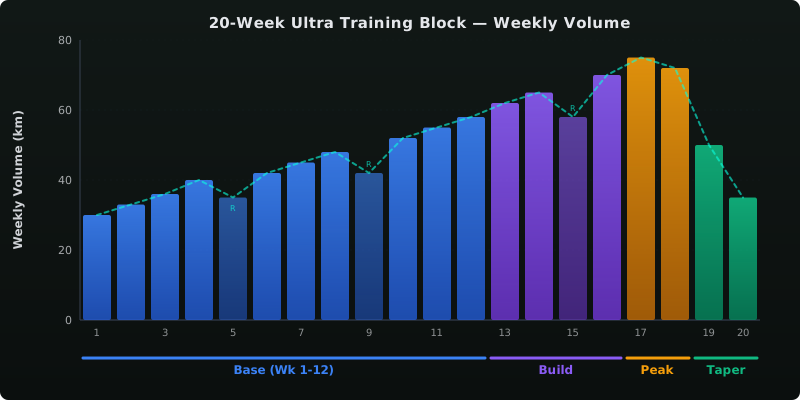
That’s the textbook version. And it works — when you’re a professional athlete with a coach, a physio, a nutritionist, and zero school drop-offs.
For the rest of us, the pyramid looks more like a pyramid that someone sat on. There are dips where life happened, spikes where you crammed in extra sessions out of guilt, and at least one week-long gap where the whole family got gastro.
That’s fine. The shape still matters, even if it’s imperfect. You want to generally trend upward in volume, hit a peak, then pull back before race day. The details are flexible. The direction is not.
Weekly Volume Over Daily Rigidity
Here’s the single biggest shift that improved my training when life got complicated: stop thinking in daily sessions and start thinking in weekly volume.
Instead of rigidly planning Monday 10km, Wednesday 15km, Thursday hills, Saturday 30km — which falls apart the moment a kid gets sick or a work deadline moves — I set a weekly kilometre target and fit it in however I can.
If the target for the week is 70km, I don’t care whether that’s five runs or seven. I don’t care if Tuesday’s run happens on Wednesday instead. What matters is that by Sunday night, the volume is roughly where it needs to be.
This does a couple of things. First, it removes the guilt of missing a specific session. You didn’t fail Wednesday’s plan — you just need to redistribute a few kilometres across the remaining days. Second, it gives you permission to be opportunistic. Kid napped for three hours on Saturday? Great, that’s your long run sorted. Meeting cancelled on Thursday afternoon? Sneak in a quick trail session.
The weekly target should still follow the pyramid shape — building over the training block, peaking, then dropping into taper. But within each week, you’ve got flexibility to be human.
The Non-Negotiables
Flexibility doesn’t mean randomness. Within that weekly volume, there are a few session types that need to show up regularly:
The long run. This is your bread and butter. It needs to happen most weeks, and it needs to get progressively longer as you approach your peak phase. For a 100km race, you want to be hitting 35-50km in your longest training runs. For a 50km, somewhere in the 25-35km range. These don’t need to be fast — they need to be long enough to teach your body (and your brain) what sustained effort feels like.
Strength work. I’m not talking about becoming a gym rat. I’m talking about functional strength that protects you on the trails — single-leg squats, step-ups, calf raises, core work, hip stability exercises. Two sessions a week, 20-30 minutes each. You can do them in your living room while the kids watch Bluey. Non-negotiable for injury prevention.
Hills. Find a hill, run up it, walk or jog down, repeat. Or better yet, find trails with elevation and run them regularly. If your race has 3,000 metres of climbing, your legs need to know what that feels like. There’s no shortcut here.
Some speed work. Not a lot. You’re training for events measured in hours, not minutes. But tempo efforts, threshold runs, or even just picking up the pace on the last quarter of an easy run keeps your neuromuscular system sharp and stops you becoming a one-pace plodder.
Everything else — the easy recovery runs, the midweek top-ups, the spontaneous trail sessions because the weather was too good to sit inside — is flexible filler that makes up the rest of your weekly volume.
Back-to-Backs: The Secret Weapon
If I could only give one training tip for ultra preparation, it would be this: run back-to-back long runs.
Saturday long run, Sunday long run. Not necessarily the same distance — maybe 30km Saturday, 20km Sunday — but the second day is the magic. Running on tired legs teaches your body things that fresh-legged running never will. It trains your slow-twitch fibres to keep firing when they’d rather not. It teaches your brain that “I’m tired” doesn’t mean “I’m done.” It simulates the middle-to-late stages of an ultra far more effectively than a single monster run.
Back-to-backs are also more practical for most people. Finding time for one 50km training run is a logistical nightmare when you have a family. But a 30km Saturday morning and a 20km Sunday morning? That’s manageable. You still get most of your weekend. The kids barely notice you were gone. Everyone wins.
I try to fit these in every 2-3 weeks during the build and peak phases. They’re hard, but the confidence they give you heading into race day is enormous.
Training for the Dark: The 4x4x48
If your target race includes night running — and most 100km+ races do — you need to practice running in the dark while exhausted. Not just running at night on fresh legs. Running at night when your body wants to sleep.
One of the best ways I’ve found to prepare for this is David Goggins’ 4x4x48 challenge: run 4 miles (roughly 6.5km) every 4 hours for 48 hours. You don’t sleep properly. You run at 2am. You run at 6am. You run at 10am. You do it again.
It’s not about the distance — 48 miles across two days is moderate for anyone training for an ultra. It’s about running on disrupted sleep, managing fatigue across multiple efforts, and getting your body accustomed to performing when every signal it’s sending says “stop, lie down, this is ridiculous.”
I wouldn’t recommend this more than once or twice in a training block, and keep the pace easy. It’s a mental and logistical training tool, not a fitness session. But if you’ve done a 4x4x48 a few weeks before your race, those 2am kilometres through the forest will feel familiar rather than terrifying.
Consistency Over Perfection
I keep coming back to this, because it’s the thing that matters most and gets talked about least: consistency is the key.
Not heroic efforts. Not one legendary 60km training run that leaves you wrecked for two weeks. Not smashing yourself in a speed session because you feel guilty about missing three days.
Consistent, sustainable, week-after-week effort. Showing up even when the session isn’t exciting. Running easy when your ego wants to go hard. Resting when the plan says rest even though you feel good. Building the aerobic base that underpins everything else.
I’ve had training blocks where I nailed every session and arrived at races feeling overtrained and flat. I’ve had blocks where life chaos meant I only hit 70% of my planned volume but stayed consistent and healthy — and ran personal bests. The difference wasn’t fitness. It was freshness and consistency.
If you’re consistently running 4-5 times a week, hitting your long runs, doing your strength work, and generally trending in the right direction — you’re doing enough. You don’t need perfection. You need persistence.
When to Outsource the Thinking
There’s a lot of mental load that goes into building a training plan. Calculating weekly volumes. Deciding when to peak. Figuring out how to taper. Balancing intensity and recovery. Adjusting for the weeks when everything goes sideways.
Some people thrive on that. They love the spreadsheet, the colour-coded calendar, the satisfaction of ticking off sessions. If that’s you, lean into it. The process of planning can be motivating in itself.
But if the planning feels like another job on top of the training itself — and especially if it’s stopping you from starting — it’s worth considering outsourcing the structure. There are plenty of coaching options, from fully personalised plans to AI-generated frameworks that adapt to your schedule and goals.
We built RacePlan for exactly this — to take the guesswork out of race preparation and give you a structured plan you can adapt to your life. It won’t replace the actual running, but it can handle the thinking so you can focus on the doing.
Whether you plan it yourself or get help, the important thing is having some structure. Winging it works for short races. For ultras, you need a direction, even if the path wanders.
Listen to Your Body (No, Actually Listen)
This sounds like generic wellness advice, and I know that. But in ultra training, where the line between productive stress and injury is paper-thin, it genuinely matters.
There’s a difference between “I’m tired and I don’t feel like running” and “something is wrong.” The first is normal — push through it, you’ll feel better by kilometre three. The second is your body telling you to back off before a niggle becomes a six-week injury.
I’ve learned to pay attention to a few specific signals:
- Sharp pain that changes your gait — stop. Walk home. Reassess tomorrow.
- Fatigue that doesn’t clear after a rest day — you’re accumulating more stress than you’re recovering from. Drop volume for a week.
- Elevated resting heart rate for multiple days — your body is fighting something. Easy week.
- Persistent loss of motivation — sometimes this is mental staleness, not laziness. Mix up your routes, run with someone, or take two days completely off.
The goal isn’t to get to race day having completed every session. It’s to get to race day healthy, fit, and genuinely excited to run. Sometimes that means doing less.
Tying It All Together
Ultra training isn’t complicated. It’s just hard to sustain. The principles are simple: build gradually, train specifically, recover properly, taper intelligently. The challenge is doing that consistently for 16-20 weeks while also being a functioning adult.
So give yourself grace. Use weekly volumes instead of rigid daily plans. Prioritise consistency over heroics. Run your back-to-backs. Do your strength work. Test your nutrition and gear in training, not on race day. And when the plan falls apart — because it will — focus on the direction, not the details.
Get your shoes and pack sorted early in your training block so you’re not breaking in new gear close to race day. And tie your training plan to your race plan — when you know what the course demands, you can train for those specific demands rather than just accumulating generic fitness.
The start line is waiting. You don’t need to be perfect to stand on it. You just need to be consistent enough, healthy enough, and stubborn enough to keep showing up — on the dark mornings, the tired legs, the weeks that didn’t go to plan.
That’s what gets you there. Every time.
Generate a personalised race plan with AI
Get a customised nutrition and hydration plan based on your weight, pace, and race conditions. Free to use.
Related Articles

Train the Plan: Why Your Race-Day Nutrition Strategy Starts Months Before the Start Line
Race-day fuelling is equal parts art and science. How to build, test, and iterate your nutrition plan in training so there are no surprises when it counts.

The Science of Race-Day Fuelling: How Many Calories Do You Actually Need Per Hour?
Evidence-based breakdown of caloric intake for ultras. Why 250 cal/hr is wrong for most runners. Calculate YOUR number based on weight, intensity, and duration.

There Is No Finish Line: How to Plan, Prepare and Crew a Backyard Ultra
A planning and crew guide to the backyard ultra — how to pace the loop, set goals when everyone DNFs but one, and crew the race with no finish line. Sydney's BYU in focus.